Tuesday, October 25, 2016

Lake Anna Adventure


Lake Anna
This quote sums up so much of my need for adventure. There is a belonging in the adventure to a wild place. The finding of the home that exists within myself. Labor day weekend this year a buddy of mine from Ashland and I headed down to the Trinity Alps to meet two of my cousins coming up from San Francisco. We arrived late Friday after work and hit the trail in the dark. On our drive down we drove through exceptionally thick smoke from forest fires. I was worried that we might be smoked out at the trailhead. But when we arrived we were heralded by the stars. We busted through a few miles and ended up in a beautiful valley with the stars twinkling overhead. The light in the morning was sublime, the smoke made an orange glow that was filtered through the old growth firs and cedars. Waking up to birdsong and the wetness of the dew on my sleeping bag was so comforting. After breakfast we continued up the valley on our way  to Lake Anna. We went off trail in our quest and worked our way up the valley and onto the ridge until we found the gorgeous deep blue of the cirque lake. Without delay we swam and basked on the rocks letting the tingling sensation of the cold fade away. We made camp overlooking the lake and headed up the knife like peaks to get a panoramic view. The smoke shrouding the land below was so surreal, we were in an island in the sky; Just above the smoke that was enveloping the land below. Our home for the next two nights was nestled under a beautiful old growth tree, that night we heard the call of the Great Horned Owl. The following day I had a yearning for an adventure, there are a vast number of peaks and lakes in a very small area. My cousin Chad and I decided to see how many we could visit in a day. We set out crossing the saddles between the mountains and hiking off trail carving straight-ish lines between our destinations. We summited mountains and swam in multiple beautiful lakes. It was a day of ultimate questing, with only a small day pack between us we covered many miles of up, down and back again. Returning to camp we figured that we made a 5 lake loop and covered about 8 miles. I missed this feeling of raw adventure: sleeping under the stars and moving lightly over the land. This trip brought me back home and helped me settle back into what it means to be at home in nature. I belong to the wild places, I thrive and find my power when I am deep in the wilderness of the world. Without this I wouldn’t be me and I would be utterly lost in the churning of our modern world. 

Deer Lake and Siligo Peak

Wednesday, October 12, 2016

Why I Adventure

 Adventure is deeply rooted in the psyche. When we could have stayed in central Africa we chose to wander. We explored and pushed the boundaries of the known world until we spanned every continent and ocean on this planet. Now we have taken this innate sense of expansion and taken it beyond the limits of our home planet. Every human has a different sense of adventure, yet it lives within us all.
I choose to adventure because it fulfills a deep need to push my own boundaries, to seek the wild places, the moments in which I could never have fathomed, to stretch myself into the unknown and come back changed. Adventure can take on many forms, from epics that involve airplane flights to far away places, to backyard rambles. It is the focus, the purpose behind the action that makes it an adventure. When we let the preconceived fall away and step into the unknown we are on an adventure. 
This past year my eyes have been set on the ocean. I have been cultivating a deep appreciation for one of the most foreign environments for our bi-pedal species: water. Deep water scared me when I was young. I wouldn’t go into water that I couldn’t see into, murky deep water gave me the heebie-jeebies. I was a teenager before I was really comfortable swimming in lakes, rivers and eventually the ocean. Surfing has always held an allure for me, when I started to surf I saw the ocean in a new light. A force to be reckoned with, but also one that can be harnessed and danced with. Surfing has taken hold of my heart, it is so raw, there are so few ingredients needed to make an amazing moment happen. 
Driving from Ashland to the coast is an adventure, we traverse multiple bioregions and travel along the last un-dammed river in California, the Smith River. Once we arrive it is time to assess conditions, almost never do we surf where we envision. There are so many nooks and crannies that catch the swell directions; or keep the wind at bay, so many factors that can really only be weighed once we arrive.
Plunging into the water with only a board underneath, and in the northern latitudes a wetsuit, is a leap of faith. Fighting the breaking power of the waves to get beyond them is the first test. One that has sent me sprawling back on the beach many times. Once that is complete you have to be patient. Bobbing in the ocean like a seabird, waiting for the right moment and wave to begin the next test. Can you paddle strong enough to catch the surging beast? There is something so raw about a wave, a pulse from some distant place in the ocean that when it gets close to land rises up and roars. Surfing has captured my soul and embodies so much of what I call adventure. 

Sunday, March 24, 2013

My first Ecuadora!

Diana teaching me to weave!

Two days ago I completed my first Ecuadora, it only took me about 20 hours from start to finish. Much slower than the eight hour average of the weavers. It's a time consuming process to weave a hat from start to finish, there are many tricks that I never would have been able to figure out on my own. Thankfully I had the inventors of the Ecuadora to teach me.

Day Two, learning to make my first pattern

In the beginning as the base grows new wefts (The fibers running vertically in the photo, sticking out of the bottom) need to be added periodically, meaning that apart from focusing on the weaving itself I had to be constantly aware of when to add more wefts. The wefts are always Toquilla Palm because it is more rigid than the plantain bark. 

Trying out a top hat while I work

Once enough wefts have been added it's smooth sailing for a little while, nothing to to but continue going round and round. Until I got to the level of the closure. Then it gets tricky again, I had to learn to weave in reverse, weave in one direction towards the gap, and then turn around and head back the way I came. This played quite a trick with my mind and it took a while before I got it down without messing up, almost every time I would turn around I would get stuck and have to think about the process all over again. The last bit is to make the clasp itself which requieres adding new wefts sideways to pull off. This was where Diana had to take over for a minute to get me started.

Finished the cap, now onto the visor, with a fedora and Ecuatopper in progress.

The visor was pretty easy compared to what I had to complete to get to this point, every day of weaving I was getting better and faster.

Almost finished!


Stoked about my new hat! It feels great to have finally completed an Ecuadora from start to finish!


Tuesday, March 19, 2013

Montanita Fashion Week


Finale of Fireworks, they burn!

 This last week was the first annual Montanita Fashion Week, and the agency that I modeled with before was here and had two events, one on thursday and another on Saturday. Fausto arrived on Thursday to enjoy the chill vibes of Montanita with me. We were in one of the three main Bar/ Discoteques when we bumped into Martha, the owner of Schmitt Models. She wanted me to model later that evening. I had to turn her down, Fausto and I were having too much fun. On Friday I got to talk to Martha about what the deal was. The main event was Saturday evening, and she wanted me to model. I asked her if my hats could get shown as well. She agreed, her nephew Daniel designs beachwear and he was happy to have my hats accompany his shirts. He is a photographer and videographer, he made the video that I was in in September and would be filming the event on Saturday.

I arrived at Martha's house at 12 PM and then I did what models do best, wait. I spent most of the day on the beach waiting to be called to try on clothes. It turns out that I'm not a very good model down here because my waist and shoulders are too broad. The way the last two events that I've been in work is that Shmitt Models supplies the models and the designers bring their clothes for the models to try on. I was rejected by almost everyone because I couldn't fit into their shirts, jackets and pants. I was also tried out for a speedo, but my tan line is at my knees... In the end I was chosen by two different designers, one modeling underwear and the other some hideous cut up shirt and jean shorts.
Once the event gets going it is extremely stressful, there is a two minute gap between each turn. In those two minuted the model has to change and be ready to walk with a whole new outfit on. It wasn't much of a problem for me since I only appeared in three out of the 10 different turns but many models walked every time.

We weren't allowed to watch either, all of us sequestered in the building behind the runway. The designers yelling at us to get the clothes just right and the event producers trying to keep everything orderly.
The highlight was getting to see the hats shown, I snuck into the balcony and watched the models strut their stuff rocking our fedoras and top hats. Because Daniel was filming I walked out in his name as the designer of the clothes. It was a good experience, Daniel says that he's going to get me all the footage for free. I can say that our hats have been shown in a fashion show!
On monday I went to Felix and Diana's to weave and they opened the Super, the regional newspaper, and there was a picture of me and my hats!

Friday, March 15, 2013

Otavalo Adventures


                                             Double Rainbow over the Bus Terminal

I went to Otavalo in search of woolen liners for the hats and some other product ideas. I arrived in Otavalo and walked in the completely opposite direction from the center of town until I asked someone,. When I got off the bus there was a sign for a market, and I followed it. Turns out it wasn't the famous crafts market that is well known all around South America. Sometimes you've just gotta ask...
I figured it out and made it back to the market, I began asking different shops and stalls if they knew of where I could get specific work done and raw materials. I was pointed towards the bus station where I was told I would find what I was looking for. Little did I know, I would find much more.
I wandered my way up a stair case that was garland with multicolored wool. I had found the right spot. On the second floor was bags and bags of wool. The owner of the store sat through my questions about wool in Ecuador. Turns out Ecuador doesn't hardly produce any alpaca wool and all the alpaca wool items in the market come from Peru. I was asking him about how I could find people to work for me when a woman, Luz, who was buying wool told me that her and her family weaves and that I could come with her. I said sure and waited until she had made her purchase. I helped bring the three bags of wool that she bought down to an awaiting taxi truck and as I was putting it in I saw the most amazing double rainbow. I commented to her that it was a good luck sign. She said that it was for both of us. The rest of the evening we kept on repeating it to one another.
Luz and her ponchos

We arrived at her home and she took me to a room in the house where two people were working on wooden looms. She told me that her household was one of three in Otavalo proper that still weave traditional ponchos on looms. What luck! I spent the evening explaining what I was in Ecuador doing and what I am hoping that they can do for me. They were more than willing to weave what we're looking for. At some point while I was talking with the family I asked Luz's daughter Lina who is studying tourism where a good hotel might be. Luz interjected and asked if I was alone. When I told her that I was she invited me to stay the night at her house.

As were were talking two young Mormon missionaries arrived. They have been coming to this family for two weeks and that night was the night that they were going to show the Luz and her family the church. One of the Missionaries was from Utah, so we chatted about the USA. I learned that when your on a mission you can't use the internet, so was totally without contact with the happenings back in the States. It was very interesting talking to the missionaries, they firmly believed that they have the one way to god and did their best to convince me and the family to join the church. Since I didn't have much to do I decided to join the family and check the church with them. We spent an hour touring the church, my first time in a Mormon church, reading passages from the Book of Mormon and being asked questions about our beliefs. It was definitely not how I imagined spending my evening but very interesting.
We returned to the house and I got to meet the rest of the family who were back from work at that time. I ate dinner with them and turned in for the night, content and happy to have met such an open and welcoming family.

Miguel rocking the loom

Figuring it out...
The next day I learned how to work the loom with one of Luz's sons Miguel. We worked on the loom for about an hour, figured out the prices for the products and then Miguel took me to a waterfall outside of Otavalo. We had a great time wandering around the beautiful community park. There were two waterfalls, we ciimbed up above the first and we were able to swim in the pool below the second.
We hitched a ride back to town in the back of a truck and ate lunch again at the house. Luz sent me away saying, next time you come back tell us a week in advance so we can make cuy (guinea pig)!

Monday, March 11, 2013

Paragliding Adventure Part 2


After Leaving Crucita Larry, James and I headed south to another site, San Pedro. We stayed in Libertad Bolivar, about halfway between Montanita and San Pedro. We had a glorious evening flight.  Larry Flew for over an hour, I had two different flights. Handing my wing off to James so he could fly for a bit. We all enjoyed the smooth afternoon air. All of our flights on the coast were in consistent even air.
       Larry and I flying together, so incredible to be in the air with my mentor for so many years!
 The next day we tried to fly and the winds were light. When we arrived we were thoroughly questioned by the local pilots about our abilities and they wanted to see our credentials, Larry didn't bring his and I'm not even licensed yet. The day before they had been in a meeting about the site. The villagers want to make money from the tourism and tandem flights that are done there. Ecuador is trying to bring all ultralight aircraft under one umbrella, similar to USA and European standards. The guys at launch were taking the opportunity to practice their toughness. I reacted pretty strongly and told them that we flew the site yesterday and that we were perfectly competent to fly. After negotiating and another guy coming in to mellow out the fellow that approached us first the winds were too light to fly anyways. We hung out and got the download about the situation in San Pedro. Rightly so, the locals want a piece of the pie and the work at the launch. During the weekends if the winds are right the pilots may be giving over ten tandems each, $35 apiece there making pretty good money. The locals want to be hired as ground crew and given a percentage of the earnings. We were told that the fee that we were to pay to fly, $20 yearly, $5 for a day, would go towards the village. Asking further they told me that 90% would go to keeping the grass launch well maintained and 10% would go to the village. Seems to me that the villagers should get a bigger slice. The Ecuadorian built the launch, put in bathrooms and a big sign on the highway advertising paragliding in San Pedro under the funds appropriated for community development.
It was interesting to learn a little about the politics behind the well maintained launch. We had one glorious flight day so we were ok with not flying the next day. We had fun hiking out to the point that is Montanita's most interesting natural feature.
                                                        The phalic punta, of Montanita
 Larry ordered shrimp soup one day and received a single shrimp the size of his hand. When he fished it out of the depths of his bowl his first reaction was bordering on horror, he said, “ I don't know whether to eat it or run away!” All three of us laughed as Larry went to town on his shrimp.
The following day, Friday, we made the seven hour journey from Libertad Bolivar to Cuenca. James left the same day to return to Colombia. We found a nice hostal right in the old part of Cuenca. A pilot in San Pedro gave us a contact in Cuenca. We arrived on a friday and the next day was a Corn Festival in a town near Cuenca, called Paute, that also had multiple launches. The local pilots organized a fly in for the very next day. We called the pilot and he told us he would pick us up between 6:30 and 7 to get out to the launch early. We arrived early but it took a while to organize the other pilots and get us all in cars and up on the launch. When we did the launch was a steep rocky slope with a road cut 50 feet down the slope. Larry and I decided to let the other pilots launch first, to see how things went. The wind was steadily picking up and after watching some pretty hairy launches Larry and I decided to get a ride back down to the park where the festival was happening and the pilots were landing. I had tried to take out my wing but the winds began to gust so we called off any other attempts.The winds in Paute come up from the Amazon. Because of the narrow valley the winds become very strong. We were reading winds up to 35 km/hr on launch before we left. Which meant that nearer the valley floor where there were less obstructions the wind would be going even faster.
When we arrived on launch the winds were strong and super gusty, extremely difficult conditions. Both of us felt good with our decision. Other pilots were kiting, ground handling practice, in the field so Larry and I pulled out our wings and had fun in the challenging conditions. It was exceptional practice, and it served me well in my flight the next day. I had a few mishaps, draping my wing over a parked car and getting pulled off my feet by the errant wing. After the conditions got to strong Larry and I stuck around to see the rest of the festivities.
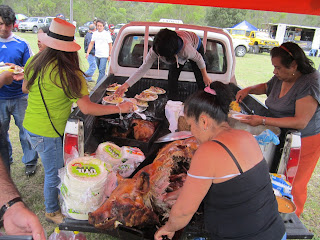
There was motorcross and off-roading going on a on a track in the park, live traditional music and a dog show. We mostly chilled in the shade until we got called for lunch, Horneado, whole roast pig. We got a plate with pig, corn and rice with a spicy salad of onions and peppers. We both ate two plates each, so tasty! After lunch we watched the off roading, tricked out jeeps and trucks taking on the track. There was nothing but caution tape dividing  the spectators from the cars as they jumped, drifted and rumbled around the track. The announcer kept on telling people to back away but that didn't really do anything. Larry and I were relaxing under a tree between the river and the track when a car lost a wheel, it literally ripped right off the axel. The wheel seemed to have mind of its own, even though it fell off the opposite side of the vehicle it barreled towards us, narrowly missing us and leaping off into the river below. One of the pilots brought a kayak so he leapt into action and saved the wheel from traveling all the way to Brazil.
On Sunday we got to fly, we launched from a much bigger site called dogs head, at 2,600 meters above sea level, and because of our kiting practice the day before we were ready for the strong winds. We had an amazing flight, both of us were glowing and content with our three day wait between flights. 
                                                        The view from Launch in Paute
That afternoon we took off for Banos, we had to make it to Quito by wednesday, because Larry's flight was set to leave on Thursday morning. We arrived in Banos late but managed to find a reasonable hotel very near the Baths that give Banos its name. Again, a pilot in Cuenca gave me the name and number of a pilot in Banos to contact. I gave him a call and we met that very evening to discuss flying the next day. Edgar Soria, the local instructor, was very welcoming and we set a time to head to Niton, the flight site. In the morning Larry and I took a hike around Banos around the hills surrounding the beautiful little city. It is nestled between the Pastaza river and the Skirt of Volcano Tunguraua. We made it back from our wonderful hike in time to eat and get over to Edgar's paragliding agency to get a car up to launch. We were met by a few other local pilots and we soon assembled and drove to Niton. The site is similar to Paute because the winds come up from the Amazon, except that just before the mountain the valley widens out, so flying is done in the afternoon rather than the morning. The sky cleared u pas we arrived to the site and we were told that we hit the best weather in two weeks. Soon we were all in the air, the site was incredible. Tungurahua cleared up and we were flying looking directly at a 5,016 meter volcano. The air was smooth for a notoriously turbulent site. We were able to get up higher than launch and fly up and down the ridge. The other pilots were doing acrobatics and having one heck of a time.
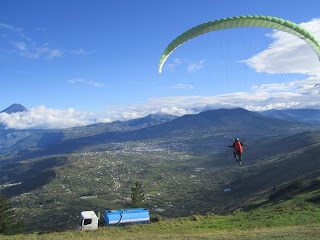
                                                    Larry taking off in front of Tungurahua
The next day Larry decided to take it easy, I went rafting down a class 4 stretch of the Pastaza River. It was an hour and a half of pure adrenaline. It had been raining a lot recently so the river was swollen, the rapids were big! I was on a boat with two other guys from the states and our guide. We paddled well and our guide was stoked that none of us fell out. The scenery that we passed through was incredible, we were rafting through jungle, waterfalls cascaded down the sides of the cliffs, it felt like we were entering the land before time. I met up with Edgar again in the afternoon, there were six people coming along for tandem flights. The weather at launch was variable and there were lots of fast moving clouds. I never flew but got to watch some of the most incredible flying I've ever seen.
The following day was Wednesday so Larry and I hightailed it back to Quito. We stayed with my old host family for a night and then my friend Rommel and I took Larry to the airport for his flight.
Larry and I had a great time traveling together, he was so easy to travel with and open to anything. I had so much fun being tour guide and translator, I think I should make it a part time profession while I'm down here. Larry is Ecuadoras first investor and we are so grateful for that. I think we got enough flying in to call our two weeks together a success. Thank you Larry!

Monday, March 4, 2013

What's in a hat?

 One of my goals while I'm down here is to learn the entire process from raw materials to woven hats. I went with Felix to a town called Barcelona about 20 minutes down the road and then further inland. We hoped on the back of his motorcycle, with helmets on, and cruised down the well maintained Ruta del Sol ( Route of the Sun). He veered off the road and took a rutted out path through the farmlands. Plants were smacking us left and right as we passed through all the rain invigorated vegetation. It was a shortcut, after passing through a creek, and many tomato fields we reached the road leading to Barcelona. We went to the house of a woman named Teresita, the head of a paja toquilla cooperative. I explained what I am doing and my desire to understand the process of the palm. We than took a tour of the village learning about the many steps along the way.
                                   Teresita Esperanza pulling the leaves into individual fibers

The toquilla palm arrives in the village in large trucks delivering the palm from the farms further inland and in the hills. The palm is harvested just before the leaves open completely, the leaves are contained in a sheath, and the first process is to remove the hard outer leaves. 
                     The bundles of Toquilla Palm above, and removing the outer sheath below.

Then the leaves are cooked in boiling water, and hung up to dry slowly in the shade. As they are drying the leaves are pulled apart into the fibers that will become our future hats. As the palm dries the leaves twist and become round. Once the leaves are dry and pulled into individual fibers they are put out in the sun to dry for a few days. The last process, is the bleaching of the palm for certain uses, the palm is hung in a wooden box and sulfur is lit in the bottom and it is left in the smoke for an hour.
                                      Lining all the roads in the village are drying palm leaves

Felix comes to this village to get his raw materials. We bought a couple bundles, strapped them on the back of the motorcycle and took off back the way we came. As we came around a corner on the overgrown single track we almost hit an old man. He was using his cane to pull down branches of a tree, called Cereza Chilena ( Chilean Cherry) we didn't even get off the motorcycle, the man pulled the branches down further and we plucked the small red fruits off the tree. After eating a handful of the delightful fruits we sped back onto the highway and back to San Antonio.